

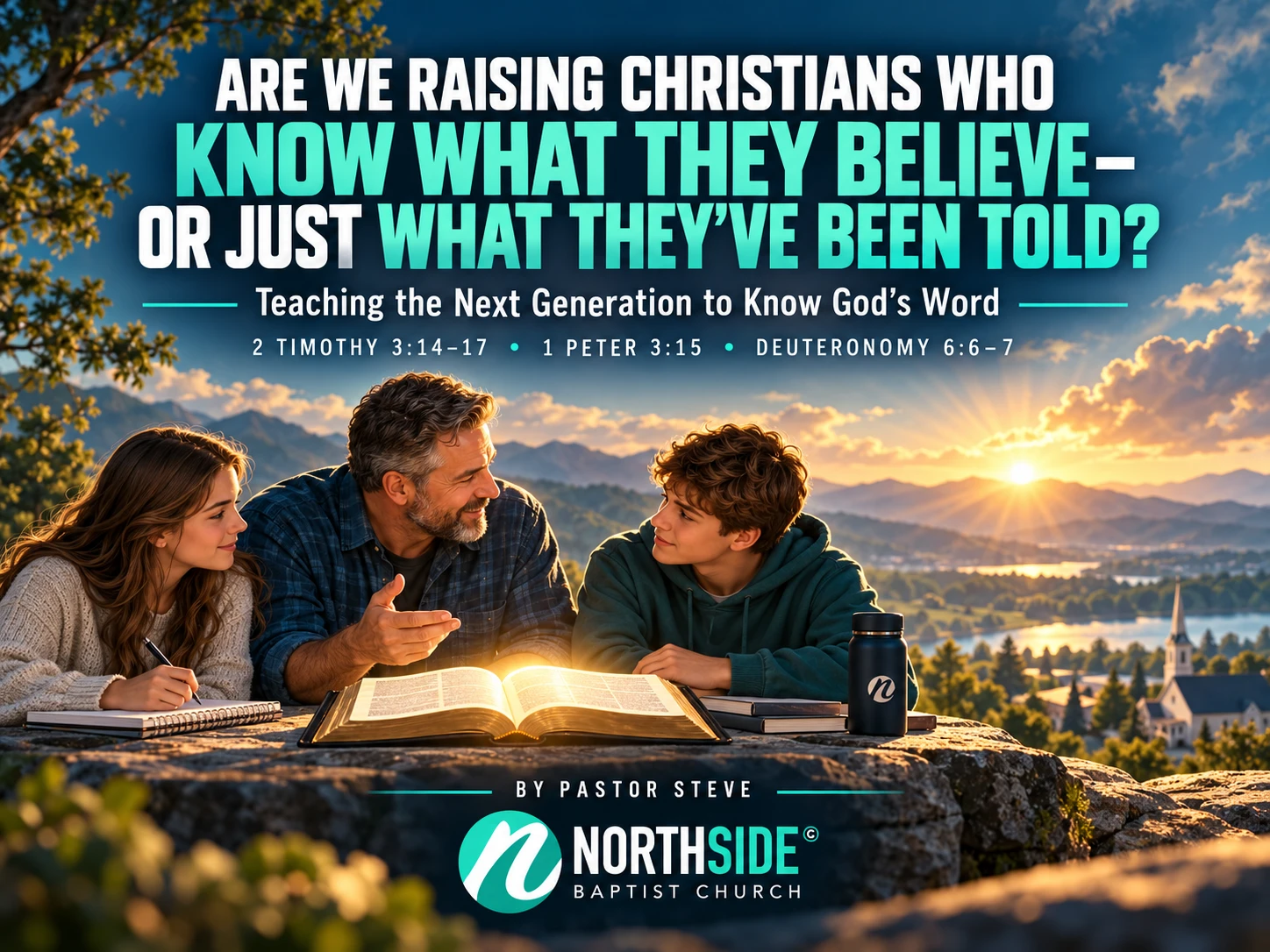
Are We Raising Christians Who Know What They Believe—or Just What They've Been Told?
By Pastor Steve Goode | Northside Baptist Church
Scripture Focus: 2 Timothy 3:14–17; 1 Peter 3:15; Deuteronomy 6:6–7
There's something that ought to concern every Christian parent, grandparent, pastor, and Sunday School teacher in America.
We have raised generations of children who know how to attend church, but have we taught them how to understand the Bible?
Now, before anybody gets upset with me, I'm not suggesting that our churches haven't done good things.
Many have invested tremendous time, love, and resources into children's and student ministries.
And I thank God for every faithful teacher and volunteer.
But I believe we need to ask ourselves a difficult question.
Are we teaching the next generation what to believe without adequately teaching them why they should believe it?
Growing Up Around Christianity
Think about a child who grows up attending church.
They learn Bible stories.
They sing songs about Jesus.
They participate in Vacation Bible School.
They attend youth activities.
They learn when to stand, when to sit, and where to find the offering plates.
But then something happens.
They graduate from high school.
They begin college, enter the workforce, or move away from home.
Suddenly, they're surrounded by people who believe very different things.
And someone asks them a question.
"Why do you believe Jesus is the only way to heaven?"
"Why do you trust the Bible?"
"What makes Christianity different from other religions?"
And their response is, "Well, that's what I've always been taught."
Friends, we need to give our young people something deeper than that.
What the Research Tells Us
Lifeway Research found that 66 percent of young adults who had regularly attended Protestant churches during their teenage years stopped attending for at least one year between ages eighteen and twenty-two.
Now, that doesn't mean all of them permanently rejected Christianity.
Some returned to church.
Others experienced temporary interruptions related to moving, school, work, or changing life circumstances.
But the research reveals something significant.
The transition into adulthood is a vulnerable time for church involvement.
And I believe we need to take that seriously.
We cannot assume that simply growing up around Christianity means someone has developed a personal, biblically grounded faith.
Attendance and understanding are not the same thing.
Neither are religious familiarity and genuine conversion.
Timothy Had a Foundation
In 2 Timothy 3, Paul reminds Timothy that he had known the Holy Scriptures since childhood.
That biblical foundation was central to his understanding of salvation through faith in Jesus Christ.
Timothy didn't simply inherit a collection of religious traditions.
He had been instructed in God's Word.
And that instruction helped prepare him for a lifetime of faithful ministry.
That's the kind of foundation our young people need.
Not merely Bible trivia.
Not merely entertainment.
Not merely another church activity.
They need the gospel.
They need sound doctrine.
They need to understand what Scripture teaches and how to study it for themselves.
Don't Be Afraid of Their Questions
Sometimes young people ask questions that make adults uncomfortable.
They may struggle with difficult biblical passages.
They may ask about suffering, science, other religions, or the reliability of Scripture.
And occasionally, our response is simply, "Because the Bible says so."
Now, when properly understood, Scripture absolutely is our final authority for Christian faith and practice.
But that doesn't mean we should discourage sincere questions.
Instead, we should help young people discover what Scripture actually says, understand its context, and recognize why Christians trust it.
First Peter 3:15 calls believers to be prepared to explain the hope they have, doing so with gentleness and respect.
That includes conversations with our own children and grandchildren.
It's Not Too Late
Parents, talk about spiritual things at home.
Grandparents, share your faith stories.
Teachers, encourage questions.
Church members, invest in relationships with younger believers.
And let them see that the Christian faith is more than a Sunday morning routine.
At Northside, I want us to be a church that passes on something of eternal value.
Not simply a building.
Not simply a set of traditions.
Not simply memories of how church used to be.
I want us to pass on a faithful understanding of the gospel and a love for the Word of God.
Because one day, our children and grandchildren will encounter voices that challenge what they've been taught.
And when that day comes, I want them to be able to say:
"I know what I believe. I know why I believe it. And my faith is rooted in Jesus Christ and His Word."
That's a legacy worth leaving.
It's a joy to be your pastor!
Pastor Steve
Northside Baptist Church
northsidegreensboro.com