

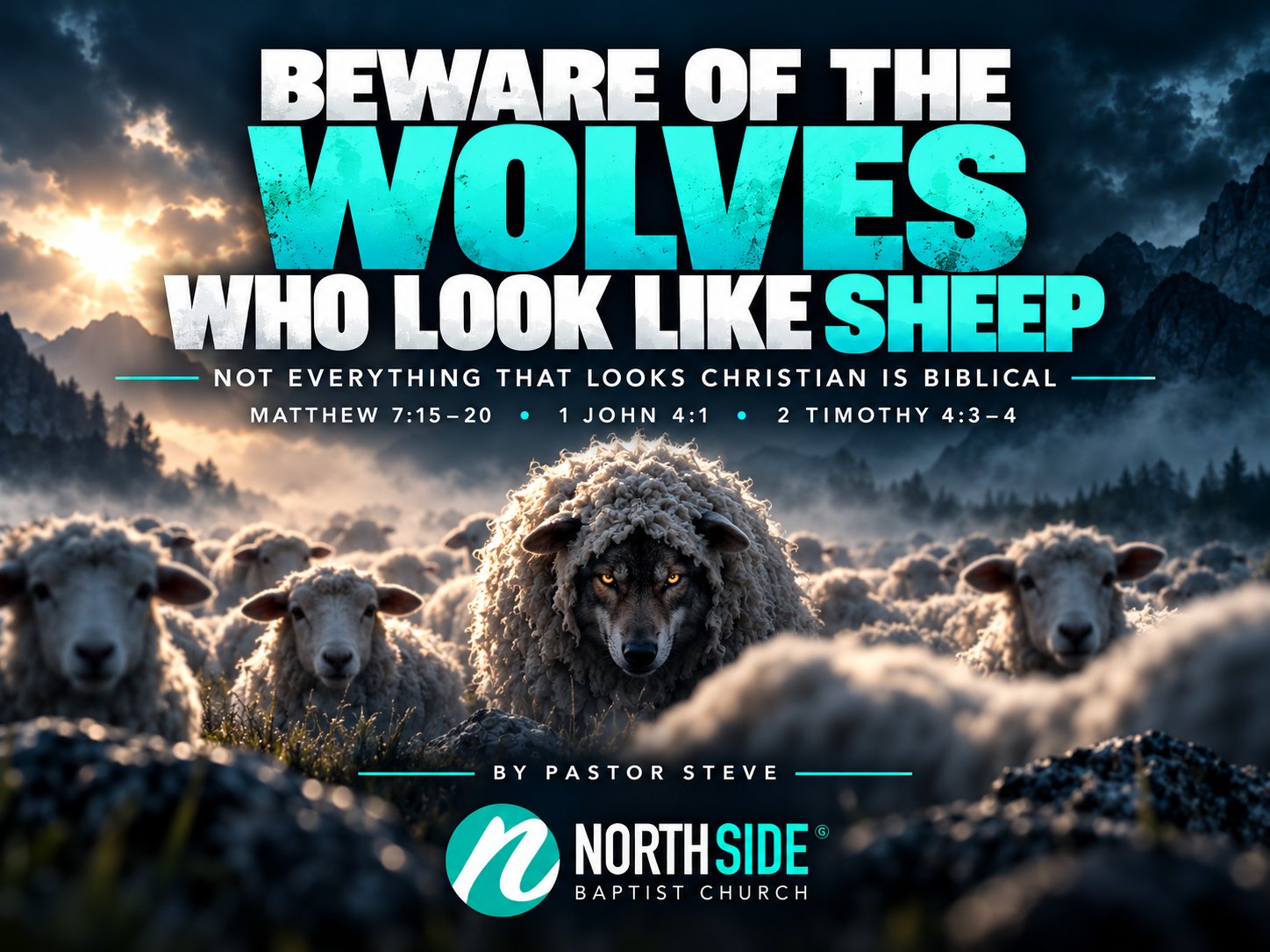
Beware of the Wolves Who Look Like Sheep
By Pastor Steve Goode | Northside Baptist Church
Scripture Focus: Matthew 7:15–20; 1 John 4:1; 2 Timothy 4:3–4
I have a question for you.
If a wolf walked into a field full of sheep, growling, showing its teeth, and announcing that it was hungry, what do you suppose those sheep would do?
I imagine they'd scatter pretty quickly!
But what if that wolf could disguise itself as another sheep?
What if it could quietly move among the flock without attracting attention?
Now we have a much more dangerous situation.
And that is precisely the picture Jesus gives us when He warns about false prophets in Matthew 7:15.
He describes wolves who come dressed like sheep.
In other words, the greatest spiritual dangers don't always look dangerous.
Not Everything That Sounds Christian Is Biblical
One of the things that concerns me about modern Christianity is how easily people can confuse an impressive presentation with sound biblical teaching.
A preacher may have a beautiful church building, a television ministry, thousands of online followers, and a tremendous ability to communicate.
But none of those things guarantees that the message is true.
Some of the most effective religious deception happens when truth and error are carefully mixed together.
Think about it.
If somebody preached something completely ridiculous, most Christians would recognize it immediately.
But what happens when ninety percent of a message sounds biblical and the remaining ten percent subtly changes the meaning of the gospel?
That can be much harder to recognize.
And it's exactly why we need biblical discernment.
Jesus Said to Examine the Fruit
In Matthew 7, Jesus explains that we can recognize false prophets by their fruit.
What does that mean?
We need to pay attention to what people teach and how they live.
Does their teaching agree with Scripture?
Does their ministry point people toward Jesus Christ or toward themselves?
Do they demonstrate humility and accountability?
Are they willing to receive correction?
Do they treat people with compassion and integrity?
Now, we need to be careful here.
No pastor is perfect. No Christian teacher gets everything right all the time.
A mistake doesn't automatically make somebody a false prophet.
But there is a significant difference between a sincere believer who makes an error and someone who persistently distorts Scripture, exploits people, or refuses accountability.
Jesus tells us to be discerning, not gullible.
The Problem With Itching Ears
Second Timothy 4 warns that people will increasingly seek teachers who tell them what they want to hear.
That's an uncomfortable warning because it doesn't simply point a finger at the preacher.
It points a finger at the congregation, too.
Sometimes the problem isn't that people cannot find the truth.
It's that they don't want the truth.
They want someone to validate their decisions.
They want a message that makes them feel comfortable.
They want encouragement without correction, forgiveness without repentance, and blessings without obedience.
And believe me, there's always going to be somebody willing to give them that message.
But an attractive message isn't necessarily a truthful one.
And a comforting lie is still a lie.
Discernment Without Becoming Cynical
I don't want Christians walking around suspicious of every pastor, ministry, or Bible teacher.
That's not what Jesus intended.
There are many faithful men and women serving the Lord with integrity.
We should thank God for them, encourage them, and learn from them.
But we should also remember that our loyalty belongs first to Jesus Christ.
When someone teaches something contrary to Scripture, we have a responsibility to recognize it.
We can do that graciously.
We can do that respectfully.
But we must do it faithfully.
And let's remember something else: biblical discernment should always be accompanied by humility.
The goal is not to become an expert at criticizing everybody else.
The goal is to become so familiar with God's truth that we can recognize error when we encounter it.
The best protection against counterfeit Christianity is a growing knowledge of the genuine gospel.
So open your Bible.
Study God's Word.
Pray for wisdom.
And be careful who you allow to influence your understanding of God.
Because sometimes the wolf doesn't look like a wolf.
Sometimes he looks remarkably like a sheep.
It's a joy to be your pastor!
Pastor Steve
Northside Baptist Church
northsidegreensboro.com