

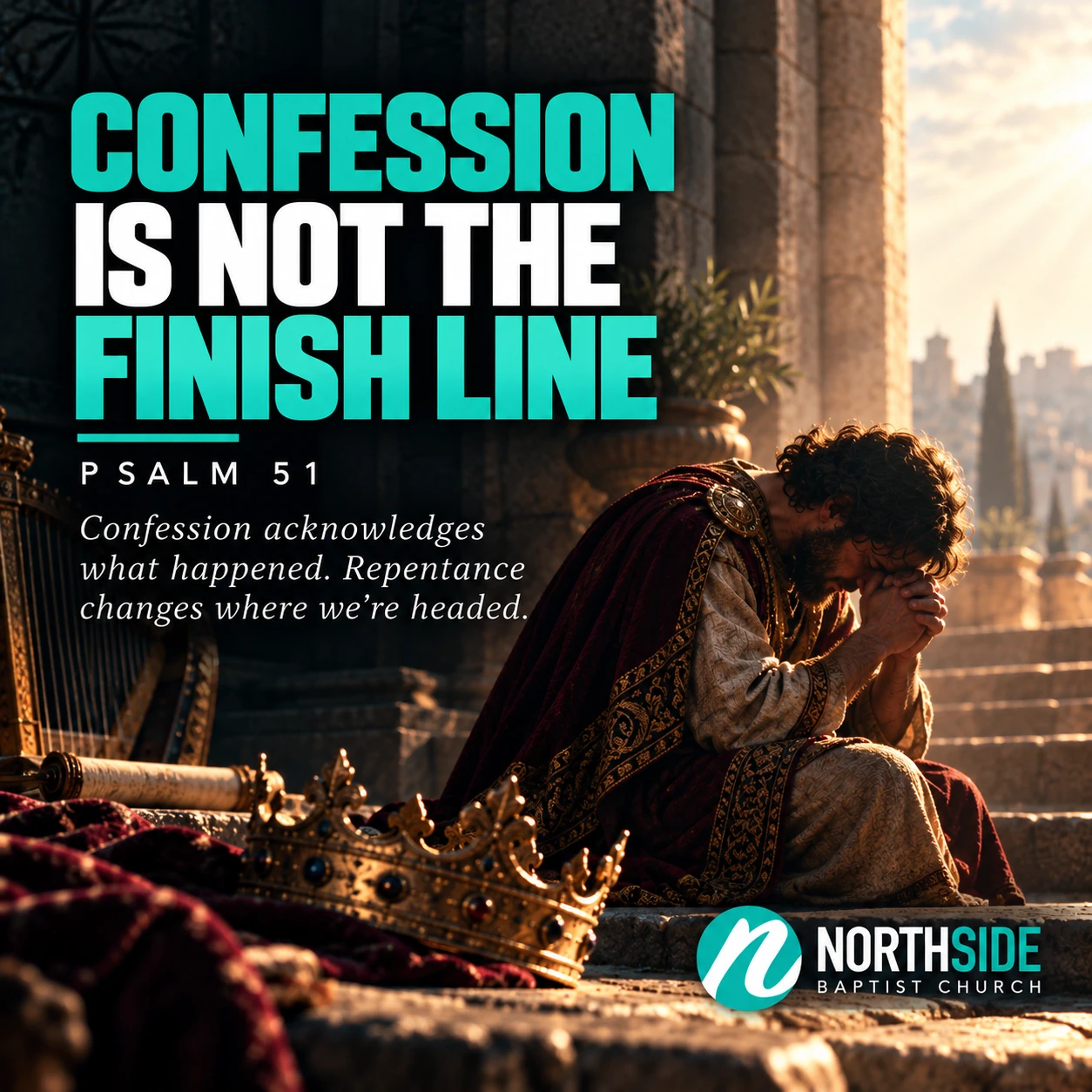
“I have sinned.”
Those are powerful words.
They are words David finally spoke after Nathan confronted him in 2 Samuel 12. David did not explain away what had happened. He did not blame Bathsheba, Uriah, the pressures of leadership, loneliness, temptation, or anyone else.
He simply owned it.
But Psalm 51 shows us something important:
David didn't stop with confession.
He wanted transformation.
There is a difference between admitting sin and repenting of sin.
A person can say, “I was wrong,” and still have every intention of eventually returning to the same behavior.
A person can apologize because they were caught.
A person can shed tears because their choices have become expensive.
A person can hate the consequences of sin without ever learning to hate the sin itself.
That is why regret and repentance are not the same thing.
Regret says, “I hate what this has cost me.”
Repentance says, “I hate what this has done to my relationship with God.”
Regret asks, “How do I get my old life back?”
Repentance asks, “Lord, how do You change my heart?”
Listen to David's language in Psalm 51.
He asks God for mercy.
He asks to be washed.
He asks to be cleansed.
And then he makes one of the most beautiful requests in Scripture:
“Create in me a clean heart, O God.”
David understood something we sometimes miss.
His greatest problem wasn't merely the situation he had created.
His greatest problem was the heart that had created the situation.
He didn't simply need better circumstances.
He needed a changed heart.
That is repentance.
Repentance means turning.
It is a change of mind that results in a change of direction.
If I have been walking away from God, repentance turns toward Him.
If I have been hiding sin, repentance brings it into the light.
If I have been excusing sin, repentance begins fighting it.
If I have been blaming everyone around me, repentance says, “Lord, start with me.”
That doesn't mean a repentant Christian never struggles again.
It doesn't mean temptation immediately disappears.
It doesn't mean there will never be another failure.
But it does mean something has changed about the direction of the person's heart.
And this is where we must understand grace correctly.
Grace is not God saying, “It doesn't matter how you live.”
Grace is God saying, “You don't have to keep living there.”
Paul asks in Romans 6 whether Christians should continue in sin so that grace might increase. His answer is emphatic: certainly not.
Grace doesn't merely pardon us from yesterday.
Grace begins transforming how we live tomorrow.
Maybe you have confessed something repeatedly, but you've never seriously begun turning from it.
Perhaps the prayer you need isn't simply:
“God, forgive me.”
Maybe it needs to become:
“God, change me.”
David wanted more than relief from guilt.
He wanted a clean heart.
He wanted a steadfast spirit.
He wanted the joy of walking closely with God again.
That is the difference between confession and genuine repentance.
Confession acknowledges what happened. Repentance changes where we are headed.
And both are part of the road home.