
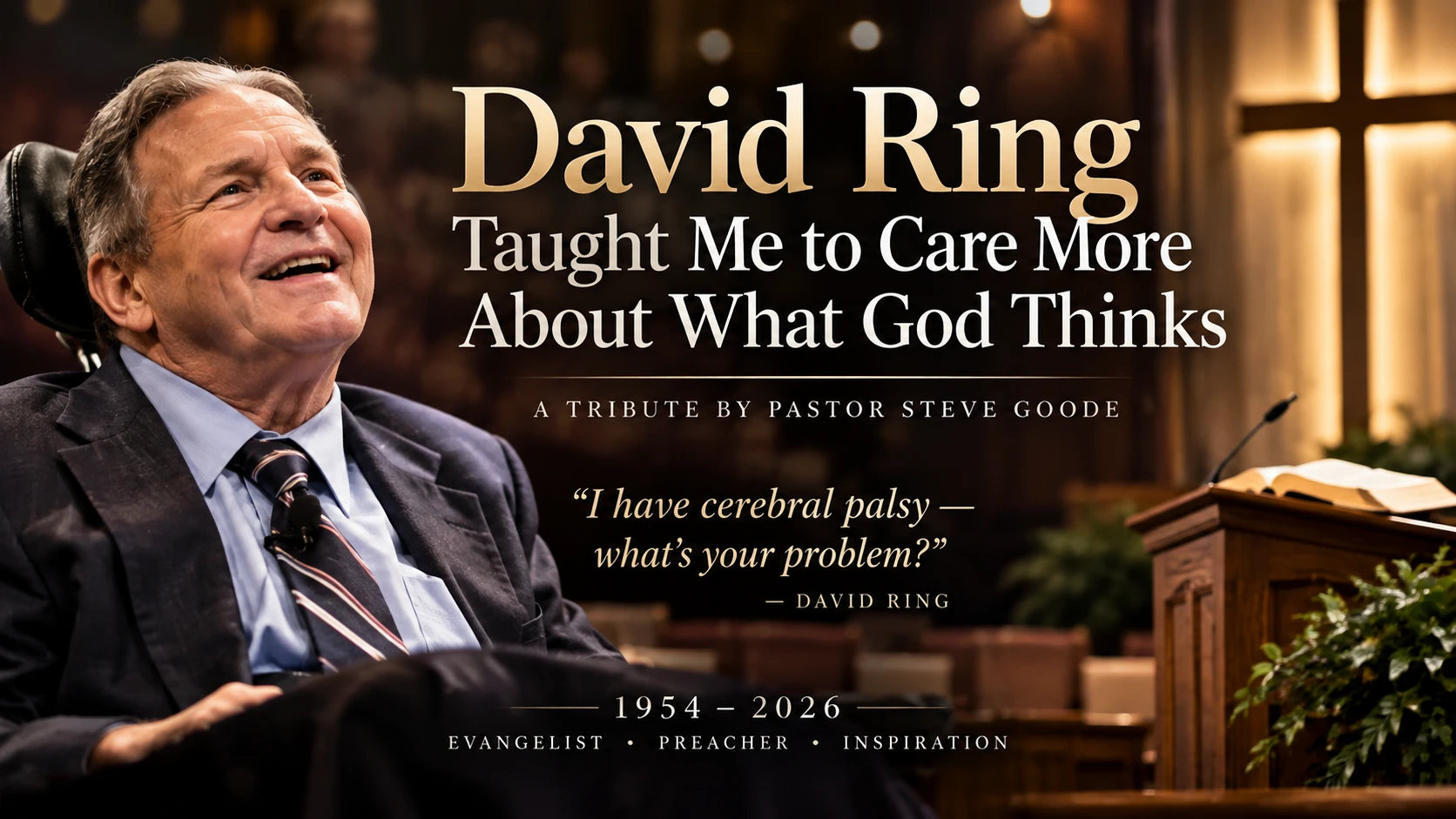
This week, I lost one of my heroes.
Evangelist David Ring passed away on September 26, 2026, at the age of 72. For more than fifty years, David traveled the country sharing the Gospel and telling the story of how God used a man with cerebral palsy in ways many people might never have imagined.
But for me, David Ring was more than a well-known evangelist.
He helped shape the way I understand ministry.
I first became familiar with David when I was a teenager living in Pell City, Alabama. My father, Dr. Robert J. Goode, was the senior pastor of First Baptist Church there. David was preaching in churches all over the country during those years, including Thomas Road Baptist Church in Lynchburg, Virginia.
Later, in 1983, I attended Liberty Baptist College, and I still remember David coming to Thomas Road and preaching while I was there.
There was something about him that was impossible to ignore.
David lived with cerebral palsy, and he never tried to hide it. In fact, one of the lines for which he became famous was:
“I have cerebral palsy. What’s your problem?”
That statement could make you laugh, but there was a powerful truth behind it.
David taught me that the limitations I placed on myself were not good enough excuses for disobeying what God had called me to do.
He taught me that ministry is not about looking the part.
It is not about impressing people.
And it certainly is not about spending your life worrying about what everybody else thinks.
It is about being obedient to God.
One of David’s messages that affected me most dealt with the way churches sometimes treat people differently based on their appearance or social standing.
James warns us about showing favoritism—giving one person the best seat while treating someone else as though they are less important.
David illustrated that message in a way I have never forgotten.
He would begin looking like the preacher people expected to see. Then he would pull his coat partly off, kick off his shoes, reveal worn or mismatched socks, untuck his shirt and completely change his appearance.
Then came the question.
Would you treat me differently now?
Would I suddenly matter less because I did not look like everyone else?
That lesson stayed with me.
Years later, God brought a man named Mike Stone into my life.
Mike was an alcoholic. I had actually known him from my years as a police officer. I had arrested him. I had chased him on foot. Years later, when we met again, Mike was temporarily blind, and he recognized me—not by my face, but by my voice.
Apparently, I had yelled at him enough during those police encounters that more than twenty years later he still remembered it.
By the time Mike came back into my life, he could be what people sometimes politely describe as “a hot mess.”
His clothes were rough. His appearance was rough. His life was complicated.
And there were moments when the way Mike dressed would take my mind straight back to David Ring.
I would remember that sermon.
I would remember James.
I would remember the question: Are we going to value someone according to what they look like, what they can give us, or what God says they are worth?
That mattered in the way I ministered to Mike.
Eventually, Mike lived for a time in an 11-by-13-foot tent in my backyard. And before anyone feels too sorry for him, understand that Mike had a flat-screen television and a mini refrigerator in that tent. He had a pretty good setup.
But something much more important happened there.
Mike had an estranged daughter named Amanda.
Over the course of many months, I watched that relationship begin to heal. Amanda would come over, walk out to that tent, and she and her dad would sit together watching old Westerns on television.
A father and daughter who had been separated were spending time together again.
That experience taught me something I hope I never forget:
Never give up on people.
David Ring helped keep that kind of compassion alive in me.
I came from a law-enforcement background. That kind of work can teach you to see the worst things people do. But David reminded me that ministry requires us to see beyond what a person has done, beyond how they look, and beyond whether they can ever repay us.
That conviction still shapes our ministry today.
It is one of the reasons we reach out to people experiencing homelessness.
It is one of the reasons we feed people who are hungry.
It is why I believe a church cannot decide whether someone is worth ministering to based on whether that person can contribute to the church budget.
The question is not, “What can they give us?”
The question is, “What can we give them in the name of Jesus?”
David Ring helped teach me that.
He also helped teach me something else that has become increasingly important the longer I have been in ministry:
You cannot spend your life trying to please everybody.
There will always be someone who thinks ministry should look different.
There will always be someone who questions why you are helping a certain person, spending money a certain way, reaching a certain group, or doing something that does not fit the normal church mold.
But ultimately, my responsibility is not to make everyone happy.
My responsibility is to obey God.
David Ring lived that message.
He refused to allow cerebral palsy, public ridicule, physical limitations, or other people's expectations to determine whether God could use him.
And because he refused, countless people heard the Gospel and countless others—myself included—were challenged to stop making excuses and start obeying God.
I am grateful that, as a teenager, I heard David Ring preach.
I am grateful that I heard him again during my days at Liberty.
And I am grateful that decades later, the lessons God taught me through that unusual, funny, courageous preacher are still showing up in the way I try to love people.
David, thank you.
Thank you for reminding us that people are more important than appearances.
Thank you for reminding us that our limitations do not limit God.
Thank you for reminding us that compassion must be more than something we preach.
And thank you for reminding me that when it comes to ministry, what matters most is not what everybody else thinks.
What matters is whether I have been obedient to God.
Well done, David.
Your voice may be silent now, but the lessons are still preaching.