

Jesus had completed the work necessary for our salvation. He had lived a sinless life, gone to the cross, died for our sins, been buried, and risen from the grave. For forty days after His resurrection, He appeared to His followers and gave them what Luke describes as “many proofs” that He was truly alive.
Then Jesus prepared His disciples for what would come next.
Luke opens Acts by saying that his first book dealt with “all that Jesus began to do and teach.” That word began is important.
Jesus’ ministry did not end when He ascended into heaven.
He would continue His work through His church, empowered by the Holy Spirit.
That means the church is not simply an organization preserving the memory of someone who lived two thousand years ago. We are the people of the risen Christ, carrying His message into the world today.
Before the disciples began, however, Jesus told them to wait.
That probably seemed strange.
They possessed the greatest news the world had ever heard: Jesus Christ was alive! You would think Jesus would immediately tell them, “Go tell everybody!”
Instead, He told them to remain in Jerusalem until they received the promise of the Father.
Why?
Because the mission of God cannot be accomplished merely through human ability.
A power tool can be sharp, expensive, and beautifully designed, but without electricity or a charged battery, it will accomplish very little. Churches can have buildings, budgets, calendars, programs, music, and talented people. Yet spiritual work ultimately requires spiritual power.
Then we arrive at one of the great verses of the New Testament:
“But you will receive power when the Holy Spirit has come upon you, and you will be my witnesses...” — Acts 1:8
Notice that Jesus did not say, “You might become witnesses.”
He said, “You will be my witnesses.”
The mission would begin in Jerusalem, spread through Judea and Samaria, and ultimately reach the ends of the earth.
Imagine dropping a stone into the middle of a quiet pond. The first ripple is small, but it moves outward, producing another circle and then another.
That is the picture Jesus gives us of the gospel.
Our Jerusalem is where God has placed us right now.
It is our home.
Our workplace.
Our neighborhood.
Our family.
Our circle of friends.
Our church.
From there, the gospel continues outward.
Some believers become intimidated by the word “witness.” They think witnessing requires having every theological answer or being able to preach a sermon.
But what does a witness do?
A witness tells what he knows to be true.
The Christian can say:
I was lost, and Jesus found me.
I was guilty, and Jesus forgave me.
I had no hope, and Jesus gave me hope.
I was spiritually dead, and Jesus gave me life.
The disciples in Acts eventually carried the gospel across the Roman world. They did not have television, radio, social media, airplanes, or the internet.
They had something better.
They had a risen Savior.
They had the power of the Holy Spirit.
And they had a mission.
That same mission belongs to us today.
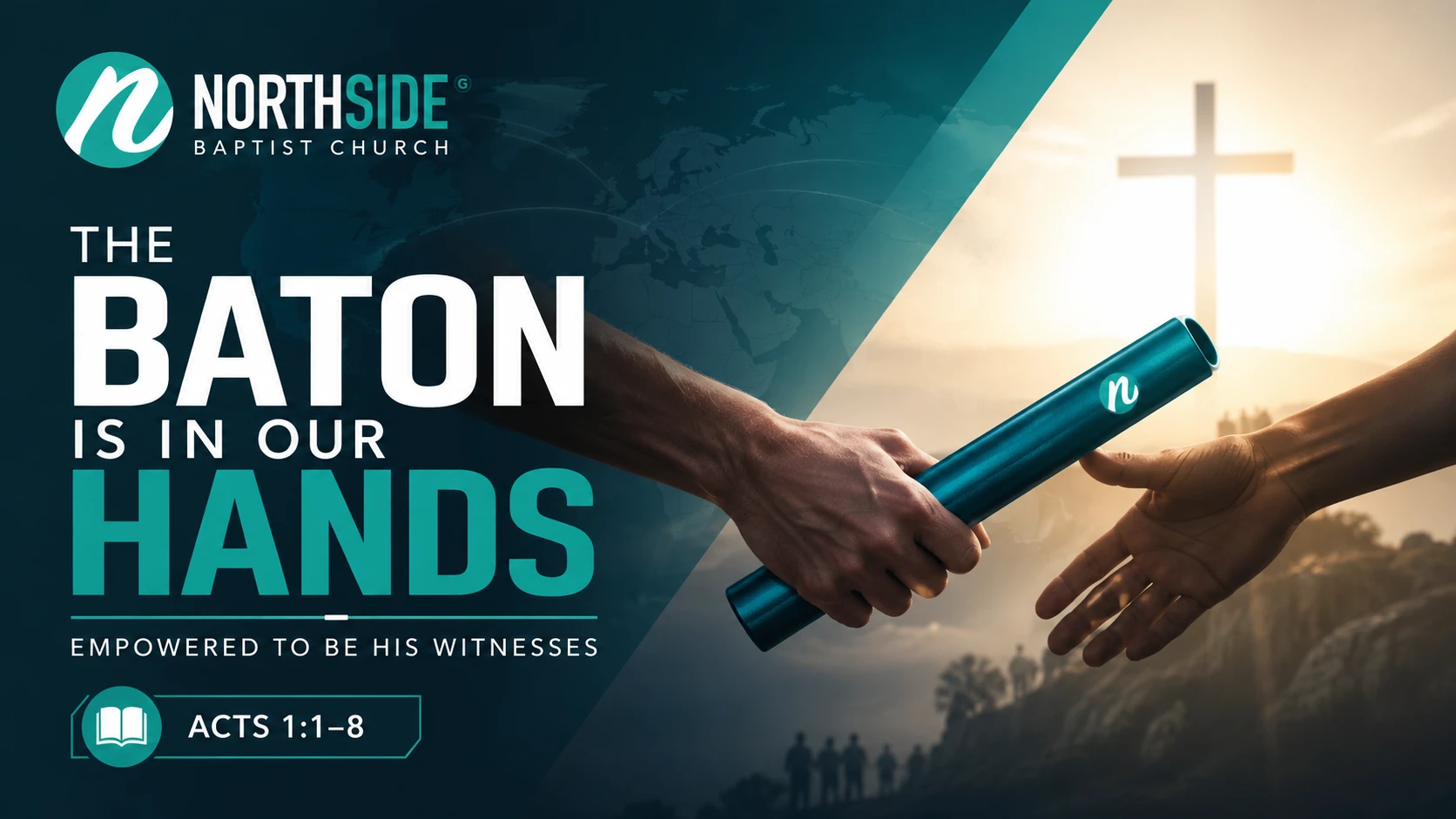
The baton has reached our generation.
The question is not whether the church has a mission.
The question is whether we will faithfully carry it forward.