

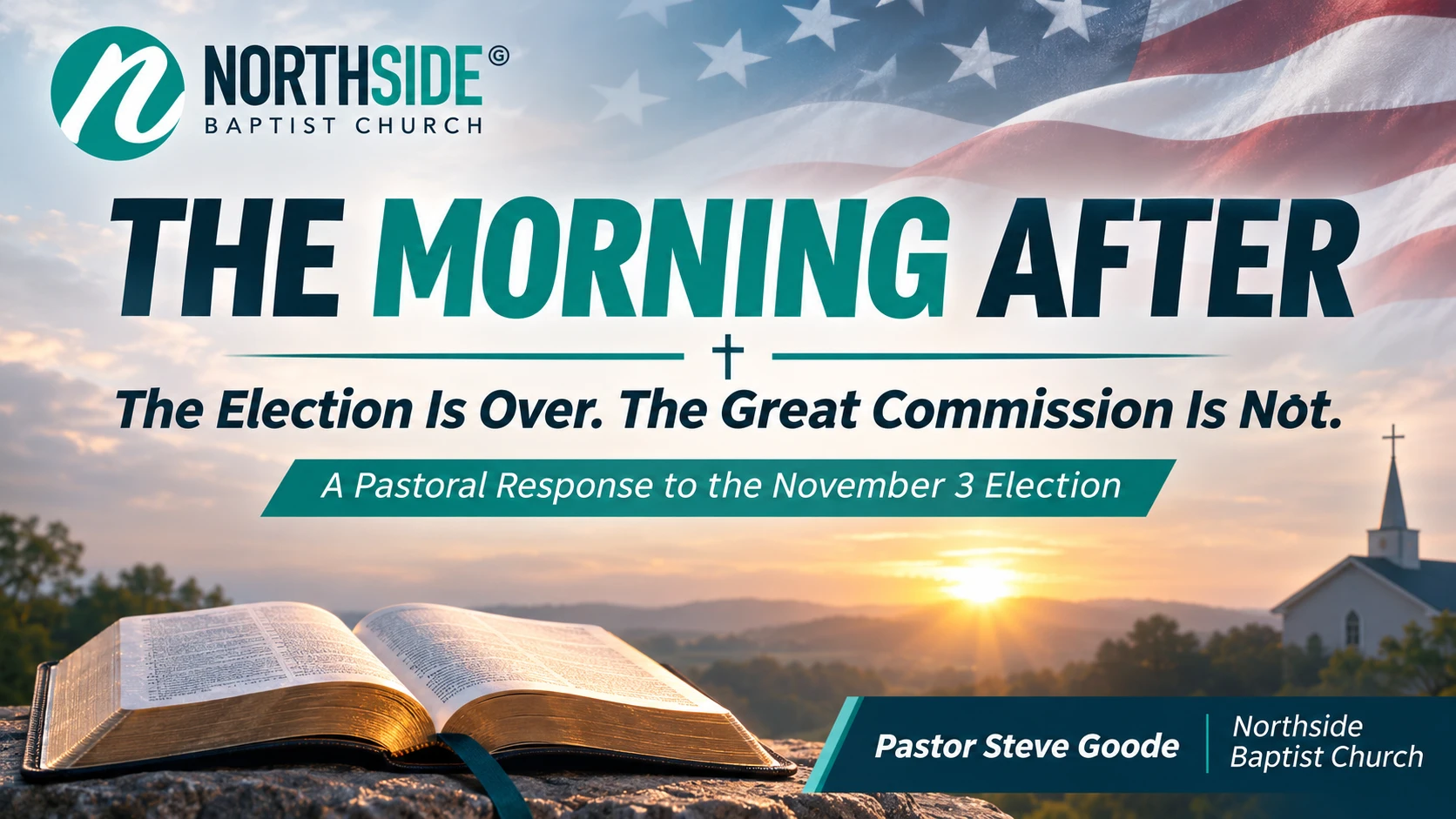
By Pastor Steve Goode
Northside Baptist Church | Greensboro, North Carolina
November 4, 2026
The votes have been cast. The results are coming in. And for many Christians across America, the morning after the November 3 election has brought more questions than answers.
What happened to our country?
Are biblical values becoming less important to the American people?
Are Christians becoming strangers in the very nation we love?
Should we be discouraged? Should we retreat? Should we simply accept that America is moving further away from the biblical principles upon which so many of us believe a healthy society depends?
Or perhaps the most important question is this:
Have we forgotten who we are, whose we are, and why God has placed us here?
As a pastor, I have spent years encouraging Christians to stand upon the authority of God's Word, to participate in the responsibilities of citizenship, and to remain faithful regardless of the political climate.
Today, I want to remind us of something that should bring every believer great comfort:
God did not lose an election on November 3. His throne was never on the ballot.
1. The Election Revealed More Than Political Differences
It would be foolish to pretend that the results of this election are insignificant.
The Democratic Party has made enormous gains nationally. For Christians who hold firmly to the sanctity of unborn human life, biblical sexual morality, parental responsibility, religious liberty, and the importance of limited government, these results naturally raise concerns.
There are genuine and significant differences between the biblical worldview and many policies advocated within today's progressive political movement.
I cannot reconcile elective abortion with the biblical teaching that human life is sacred and made in the image of God. I cannot abandon the biblical understanding of marriage and sexuality simply because cultural attitudes have changed. And I believe we must carefully examine political and economic philosophies, including socialism, according to their treatment of human dignity, individual responsibility, freedom, and care for the vulnerable.
But we must also be careful not to conclude that every person who votes differently from us rejects God or supports every position in a party's platform.
People vote for different reasons. Some vote because of economic conditions. Others because of immigration, healthcare, government spending, war, or dissatisfaction with political leadership.
An election can reveal significant differences in worldview, but it does not tell us everything about the hearts and convictions of individual voters.
And Christians must remember that neither major political party is the Kingdom of God.
Our loyalty to Christ must always be greater than our loyalty to any political organization.
2. Have We Forgotten Romans 13?
Romans 13:1 reminds us that governing authority exists under God's sovereign rule.
Think about that.
Paul wrote those words to Christians living under the Roman Empire, not under a constitutional republic that protected religious freedom.
The Roman government was not Christian. Its leaders did not govern according to biblical convictions. And yet Paul reminded believers that earthly authority was not outside God's sovereign control.
That does not mean every decision made by a ruler is righteous. Nor does it mean Christians must obey commands that violate God's Word.
When human authority contradicts God's clear commands, Acts 5:29 reminds us that we must obey God rather than men.
But Romans 13 does remind us that we should respect lawful authority, pray for our leaders, fulfill our civic responsibilities, and never confuse a disappointing election with the defeat of God's purposes.
We are commanded in 1 Timothy 2:1–2 to pray for kings and all who are in high positions.
Notice that Scripture does not say to pray only for the leaders we voted for.
The Christian response to an election is not rebellion, bitterness, or despair. It is faithfulness.
3. Maybe We Have Always Been Strangers Here
One of the questions weighing upon my heart is whether Christians have become strangers and aliens in our own country.
But perhaps we need to examine the Scriptures more closely.
In 1 Peter 2:11, believers are described as sojourners and exiles.
In Philippians 3:20, Paul reminds us that our citizenship is in heaven.
And Hebrews 11 describes faithful people who understood that they were strangers and exiles on the earth.
Could it be that American Christians have become so comfortable in our nation that we have occasionally forgotten that this world was never intended to be our permanent home?
I love America. I am grateful for the freedoms we have enjoyed, the sacrifices made to preserve those freedoms, and the opportunities we have had to proclaim the gospel openly.
But America is not heaven.
And no elected official can make it heaven.
The early Christians did not possess political majorities, friendly governments, or constitutional guarantees of religious freedom.
Yet the gospel spread throughout the Roman world.
How?
Through ordinary believers who refused to abandon their faith.
Perhaps the Church does not need greater political influence nearly as much as it needs deeper spiritual conviction.
4. Where Were the Christian Voters?
One of the troubling indications from early election analysis is that white evangelical voters represented a smaller portion of the electorate than they did in the 2024 presidential election.
We should be careful about drawing final conclusions before complete turnout data is available. A smaller share of voters does not necessarily mean every Christian constituency experienced the same decline.
But it raises an important question.
Have some Christians become discouraged, complacent, or convinced that participating in government no longer matters?
If so, that is unfortunate.
I believe Christians should take seriously the privilege of voting. We should study the issues, understand the candidates, examine their positions, and exercise our citizenship in a manner consistent with biblical convictions.
However, voting is not the ultimate measure of Christian faithfulness.
A person can cast a ballot for every candidate we prefer and still live a life that dishonors Christ.
And a person can be deeply committed to Jesus Christ while reaching different political conclusions about particular candidates and policies.
Our responsibility is larger than Election Day.
It includes how we live, how we treat our neighbors, how we raise our children, how we conduct business, and how faithfully we represent Jesus Christ in our communities.
We cannot expect a ballot box to accomplish what God has called the Church to do through discipleship and evangelism.
5. What About the Growing Influence of Other Religions?
Another development that deserves our attention is the increasing visibility and political participation of Muslim Americans.
The election has brought historic representation for Muslim candidates, reflecting changes in America's religious and political landscape.
As a Christian pastor, I make no apology for believing that Jesus Christ is the only way of salvation.
John 14:6 could not be clearer about the exclusive claims of Christ.
Christianity and Islam have fundamental theological differences concerning the identity of Jesus, salvation, and the authority of Scripture.
Those differences matter.
But we must never confuse theological disagreement with personal hostility.
Muslim Americans, like Christian Americans, possess constitutional rights to religious freedom and political participation.
We cannot demand religious liberty for ourselves while denying it to others.
Our responsibility is not to fear our Muslim neighbors, but to love them, treat them with dignity, and faithfully share the gospel of Jesus Christ with them.
The presence of people who hold different religious convictions does not change the truth of the gospel.
It simply reminds us how urgently we must fulfill the Great Commission.
6. Could Religious Liberty Come Under Greater Pressure?
This is a legitimate question.
As political and cultural attitudes change, churches and Christian institutions may encounter increasing conflicts involving religious expression, conscience protections, employment practices, biblical teaching on sexuality, and the freedom to operate according to sincerely held religious convictions.
Pastors should pay attention to legislation, court decisions, and public policies that may affect those freedoms.
We should advocate peacefully and lawfully for the constitutional protections that allow churches to proclaim the gospel without government interference.
But we must distinguish between an actual restriction of religious freedom and the discomfort of living in a society where fewer people agree with us.
Disagreement is not persecution.
Losing political influence is not necessarily persecution.
And an election victory by candidates whose policies we oppose does not automatically mean our churches will lose their freedom to worship.
However, should a day come when faithfulness to Scripture carries a greater personal or legal cost, our response has already been established by the Word of God.
We must remain faithful.
The apostles preached Christ despite opposition. The early Church continued gathering and proclaiming the gospel even under persecution.
I pray we never face those circumstances in America.
But if we do, may we have the courage to stand.
7. We Are Still Called to Be Salt and Light
Jesus did not say in Matthew 5:13–16 that His followers should become salt and light only when their preferred candidates hold office.
He commanded us to be salt and light in a world desperately in need of truth.
And that command has not changed.
At Northside Baptist Church, we have the privilege of ministering to people who are hungry, hurting, discouraged, lonely, and searching for hope.
Every week, our homeless breakfast ministry serves more than 130 meals.
Some of those people may be Republicans. Some may be Democrats. Others may not vote at all.
We don't ask how they voted before we feed them.
We serve them because Jesus loves them, and because the gospel calls us to love our neighbors.
That is what being salt and light looks like.
It is feeding the hungry.
It is visiting the lonely.
It is helping struggling families.
It is telling a lost person about Jesus.
It is loving people enough to speak biblical truth, even when that truth is unpopular.
And it is demonstrating the grace and compassion of Christ in a society increasingly divided by anger and suspicion.
The Church's greatest influence has never been determined by the number of seats a political party controls. It has been demonstrated through the transforming power of the gospel.
8. So Where Do We Find Hope?
We find it in the same place Christians have always found it.
In Jesus Christ.
Psalm 46:1 reminds us that God is our refuge and strength, a very present help in trouble.
Daniel 2:21 teaches that God changes times and seasons and removes and establishes kings.
And Hebrews 13:8 reminds us that Jesus Christ is the same yesterday, today, and forever.
Presidents change.
Congress changes.
Political movements rise and fall.
Nations experience seasons of prosperity, decline, division, and renewal.
But the character, promises, and authority of Jesus Christ never change.
Our hope was never supposed to rest in Washington, D.C.
It was always supposed to rest in the risen Savior.
And I would remind every discouraged Christian today that the gospel is just as powerful on November 4 as it was on November 2.
The tomb is still empty.
The Word of God is still true.
The Holy Spirit is still at work.
And Jesus is still saving sinners.
9. What Should Christians Do Tomorrow?
Exactly what we were called to do yesterday.
Wake up and spend time with the Lord.
Open your Bible and allow God to shape your thinking.
Pray for our president, Congress, governors, and local officials, including those with whom you strongly disagree.
Love your spouse and your children.
Be honest in your work.
Look for opportunities to encourage someone who is struggling.
Stand firmly for the sanctity of life and biblical truth.
Defend religious liberty through peaceful, lawful means.
Support your local church.
Share the gospel with someone who needs to hear it.
And remember that our neighbors are not our enemies simply because they voted differently.
The enemy would love nothing more than to see Christians become so consumed with political disappointment that we forget the mission Christ entrusted to us.
We must not give him that victory.
A Final Word From Your Pastor
I am concerned about the moral direction of America. I am concerned about the growing rejection of biblical authority. And I am concerned about what the future may hold for our children, grandchildren, churches, and religious freedoms.
Those concerns are real.
But I am not without hope.
I believe God can still bring spiritual awakening to our nation.
I believe the gospel can still transform lives, families, communities, and even the direction of a country.
I believe the Church still has an incredible opportunity to make a difference.
But revival will not begin simply because our preferred candidates win elections.
It begins when God's people humble themselves, repent of sin, return to His Word, and surrender their lives fully to Him.
So no, Christian, do not crawl into a hole.
Do not surrender to despair.
Do not allow bitterness to consume your heart.
Do not abandon your responsibility as a citizen.
And above all, do not abandon your calling as a follower of Jesus Christ.
We may be strangers and exiles in this world, but we are not abandoned. We may lose an election, but we have not lost our Savior. We may face an uncertain political future, but we serve a King whose Kingdom will never end.
America still needs the gospel.
Our communities still need faithful churches.
Our neighbors still need to see the love of Christ.
And our mission has not changed.
The election is over. The Great Commission is not.
Pastor Steve Goode
Senior Pastor, Northside Baptist Church
Greensboro, North Carolina