

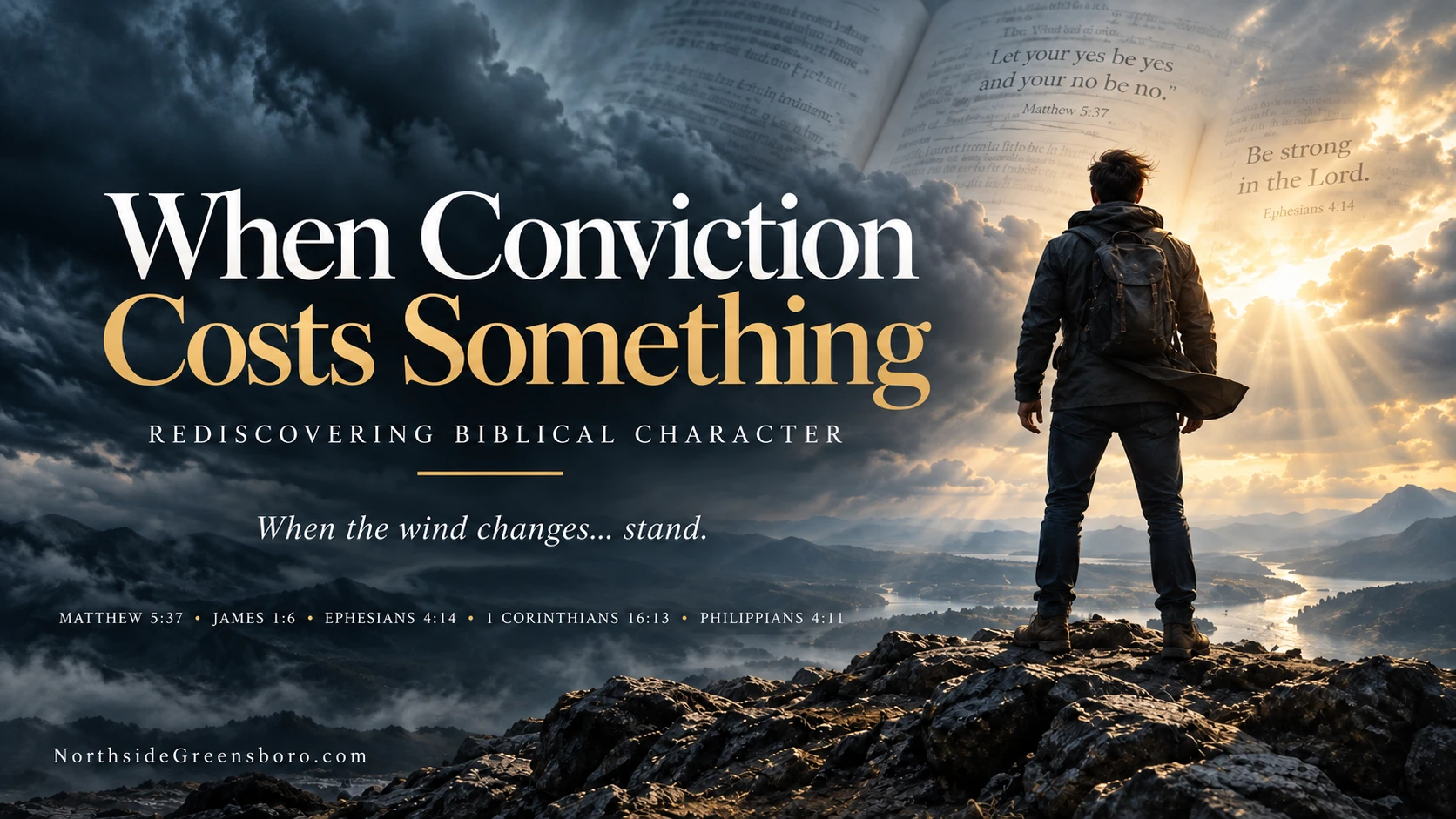
There was a time when having convictions was considered evidence of character.
A person who knew what he believed, stood by his word, kept his commitments, and refused to compromise simply because circumstances became difficult was generally respected—even by people who disagreed with him.
I am not sure that is always true anymore.
Increasingly, our culture seems to celebrate adaptability without asking what we are adapting to. We are told to evolve, redefine, reconsider, and remain “open-minded.” Certainly, humility matters. Christians should be willing to admit when we are wrong. We should listen. We should learn. We should never confuse stubbornness with godliness.
But there is an enormous difference between humility and having no anchor.
The Bible never presents a convictionless life as spiritual maturity.
Jesus said in Matthew 5:37, “Let what you say be simply ‘Yes’ or ‘No.’” James echoes that teaching in James 5:12: let your “yes” be yes and your “no” be no.
There is something wonderfully uncomplicated about that kind of character.
Your words mean something.
Your commitments mean something.
Your beliefs are more than opinions you hold until they become inconvenient.
### A Generation Tossed by the Wind
James describes the doubting person as being “like a wave of the sea that is driven and tossed by the wind” (James 1:6).
Paul uses similar imagery in Ephesians 4:14 when he warns believers not to remain spiritual children, “tossed to and fro by the waves and carried about by every wind of doctrine.”
What a picture of our age.
The wind changes, and suddenly everyone changes direction.
Public opinion shifts.
Culture shifts.
Social media shifts.
Definitions shift.
Things almost universally understood a generation ago are reconsidered, reconstructed, renamed, and sometimes completely reversed.
And the pressure upon Christians is enormous:
Don’t stand out.
Don’t offend.
Don’t be too certain.
Don’t hold convictions too tightly.
Just go along.
Blend in.
But Christians were never called to become spiritual chameleons who change colors depending upon the environment around us.
We were called to stand.
Paul writes in 1 Corinthians 16:13, “Be watchful, stand firm in the faith.”
That does not mean being angry.
It does not mean being argumentative.
It does not mean treating everyone who disagrees with us as an enemy.
It simply means that somewhere beneath our feet there must be solid ground.
For the Christian, that ground is the truth of God.
### Convictions Are Not Feelings
One of the great mistakes of our generation is defining truth according to how we feel.
Feelings matter. God created us as emotional beings. Scripture is filled with grief, joy, fear, hope, anger, disappointment, celebration, and sorrow.
But feelings make terrible foundations.
I have awakened some mornings feeling strong and other mornings feeling exhausted. I have felt confident one day and uncertain the next. I have experienced seasons where God seemed extraordinarily close and other moments when I prayed and heard nothing but silence.
If my convictions rise and fall with my emotions, I will never have convictions at all.
Biblical conviction says:
“I believe this because God has spoken, not because today I happen to feel strongly about it.”
That gives stability to a human life.
### Conviction Does Not Always Bring Happiness
We have also confused happiness with peace.
Following biblical convictions will not always make you happy.
Sometimes standing for truth hurts.
Sometimes obedience costs friendships.
Sometimes doing what is right means being misunderstood.
Sometimes saying “no” would be far easier than saying “yes.”
Sometimes saying “yes” to God requires saying “no” to yourself.
Jesus never promised that following Him would produce an uninterrupted stream of pleasant circumstances.
What He offers is deeper.
Peace.
Paul wrote Philippians from circumstances that were anything but comfortable, yet he said:
“I have learned in whatever situation I am to be content.” (Philippians 4:11)
Notice the word learned.
Contentment is not pretending everything is wonderful.
Contentment is knowing that everything does not have to be wonderful for God still to be good.
That is one of the great gifts of conviction.
When your life is anchored to something deeper than circumstances, circumstances no longer get the final vote on whether you have peace.
### Character Is Revealed When Conviction Costs You
Anyone can claim convictions when those convictions cost nothing.
Character appears when obedience becomes expensive.
Will I tell the truth when lying would protect me?
Will I keep my word when keeping it becomes inconvenient?
Will I remain faithful when compromise would make life easier?
Will I continue believing what Scripture teaches when the crowd around me says those beliefs are outdated?
Will my “yes” still mean yes?
Will my “no” still mean no?
That is character.
Not perfection.
Not arrogance.
Not refusing correction.
Character is having your life rooted deeply enough in Christ that every cultural wind does not determine your direction.
### We Need Anchored Christians
Our world does not need more Christians angrily shouting at the culture.
It needs Christians who are unmistakably anchored.
People who can disagree without hatred.
People who can love without surrendering truth.
People who can show compassion without abandoning conviction.
People whose word still means something.
People who have decided that Scripture—not popularity, emotion, politics, social pressure, or cultural fashion—will have the final authority in their lives.
There is tremendous freedom in reaching that place.
You no longer have to reinvent yourself every time society reinvents itself.
You do not have to chase every new philosophy.
You do not have to live terrified that someone may disagree with you.
You simply walk faithfully with Christ.
There may be storms.
There may be criticism.
There may even be seasons of deep sorrow.
But underneath it all there can remain something the world cannot manufacture:
Peace.
Contentment.
Stability.
Confidence in God.
The person who stands upon the truth of Scripture may bend beneath the winds of life, but he does not have to be carried away by them.
So perhaps one of the most countercultural things a Christian can do today is actually quite simple:
Know what you believe.
Know why you believe it.
Say what you mean.
Keep your word.
Love people deeply.
Remain humble.
And when the wind begins to blow—
stand.